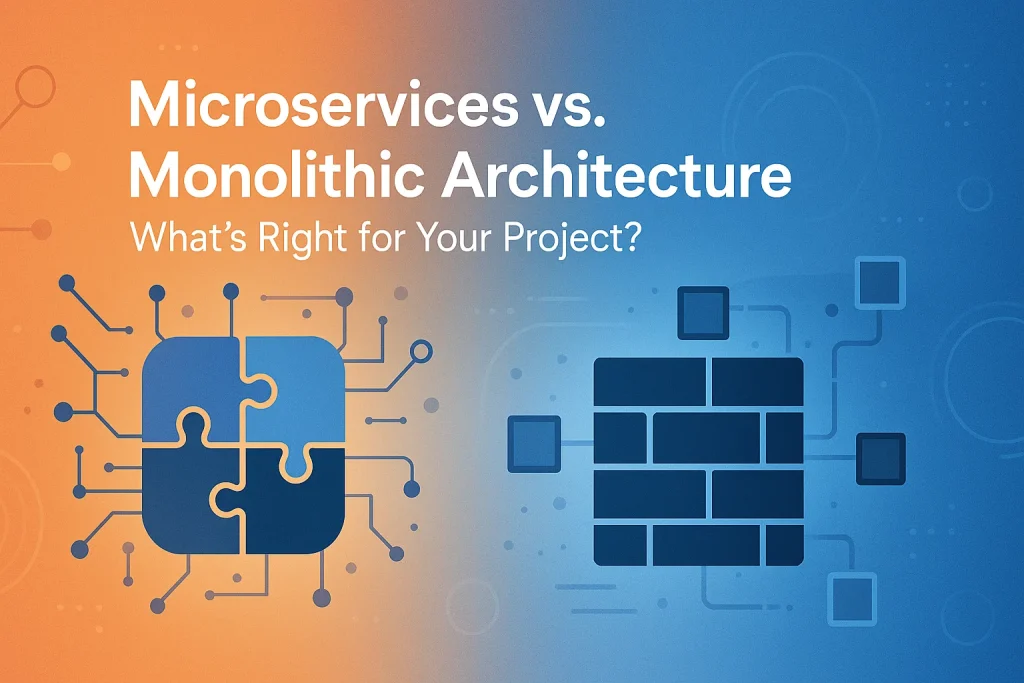
Software architecture plays a critical role in how an application performs, scales, and evolves over time. Among the most discussed architectural patterns today are Monolithic and Microservices architectures. Each has its pros and cons, and the right choice often depends on your project’s size, complexity, and future goals.
Let’s dive into the key differences, strengths, and considerations to help you make an informed decision.
🧩 What is Monolithic Architecture?
In a Monolithic architecture, the entire application is built as a single unit. All the business logic, UI components, database access layers, and other functionality are part of one interconnected codebase, deployed together.
✅ Advantages of Monoliths:
- Simpler Development & Deployment
Ideal for small teams and early-stage products. Developers can build, test, and deploy faster without worrying about multiple services. - Easier Debugging
With a single codebase, tracing bugs or logging issues is more straightforward. - Less Operational Overhead
Fewer moving parts mean fewer configurations, service discovery mechanisms, or network calls.
⚠️ Limitations:
- Scaling Challenges
You can’t scale only the part of the app that needs resources. If one feature needs more power, the whole app must scale. - Slower Development Over Time
As the codebase grows, deployments become riskier, and onboarding new developers becomes harder. - Tightly Coupled Components
A change in one module might require testing the entire application, reducing agility.
🔗 What is Microservices Architecture?
A Microservices architecture breaks an application into a collection of small, loosely coupled services. Each service is responsible for a single business capability and can be developed, deployed, and scaled independently.
✅ Advantages of Microservices:
- Independent Deployability
Teams can release updates to individual services without affecting the rest of the application. - Scalability & Resilience
Only the bottleneck services need to scale. Also, if one service fails, it doesn’t crash the whole system. - Polyglot Tech Stack
Teams can choose the best language or framework for each service depending on its needs. It refers to using multiple programming languages, frameworks, or technologies within a single application. - Faster Time to Market (at scale)
When implemented correctly, microservices allow parallel development across multiple teams.
⚠️ Limitations:
- Operational Complexity
Requires orchestration, service discovery, API gateways, monitoring, logging, and more. - Increased Latency
Communication between services (often over HTTP or gRPC) introduces network overhead. - Data Management Complexity
Maintaining data consistency across services becomes harder, requiring eventual consistency patterns or distributed transactions.
🤔 Which One Should You Choose?
✔️ Use Monolithic Architecture When:
- You’re building an MVP or a small-to-medium-sized app.
- You want to go to market quickly.
- Your team is small and doesn’t have DevOps maturity yet.
- The application doesn’t require frequent scaling of individual modules.
✔️ Use Microservices Architecture When:
- You’re working on a large, complex system that needs to scale in different directions.
- Teams are distributed and work on different modules independently.
- You expect rapid growth and need agility in deployment cycles.
- Fault tolerance and uptime are critical.
🛠 Example Use Cases
| Scenario | Best Fit |
|---|---|
| A small e-commerce startup launching its first version | Monolith |
| A SaaS product with independent modules like billing, user management, analytics | Microservices |
| An internal tool for a specific department | Monolith |
| A banking system that requires high fault isolation and regional scaling | Microservices |
💡 Hybrid Approaches: The Best of Both Worlds?
Not every application needs to strictly follow one pattern. Many organizations start with a monolithic core and slowly peel off critical components into microservices as the need arises (often called the Modular Monolith approach). This lets them avoid premature complexity while preparing for future scaling.
🚀 Final Thoughts
Choosing between monolithic and microservices architecture is not about which one is better, but which one is right for your context. Start simple. Understand your application’s growth trajectory, team structure, and technical capability. Only then decide whether to split, scale, or simplify.
Remember: good architecture aligns with your people, process, and product—not just trends.